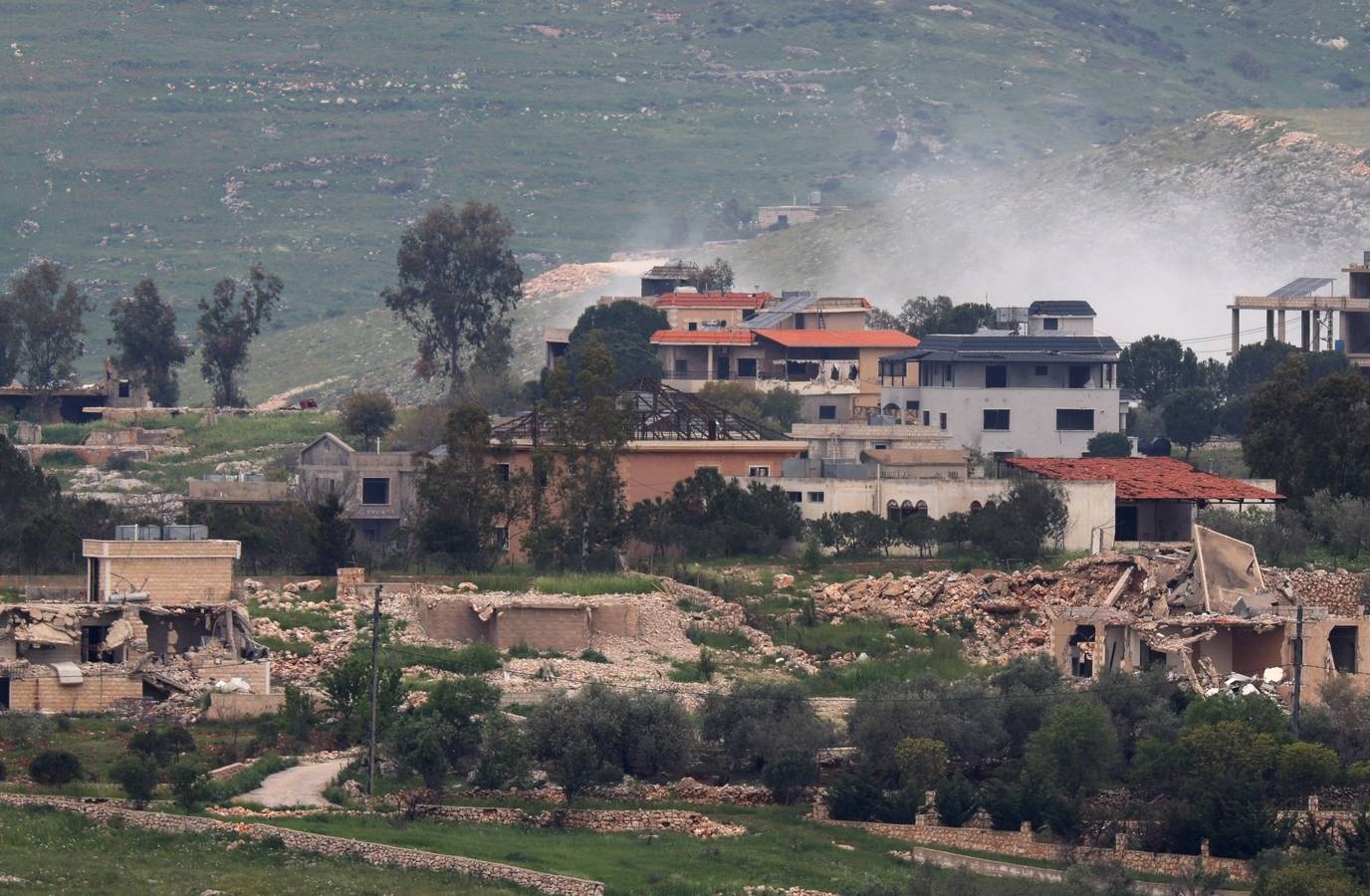
The mountain ridge overlooking Kiryat Shmona, the largest Israeli town on the border with Lebanon, is littered with fragments of drones shot down in recent weeks.
Israeli security officials claim they have a range of defensive systems capable of intercepting most of the aerial threats launched by Hizbullah, the Iran-backed Shia militia in Lebanon.
But a few drones are still getting through, triggering sirens and sending Israelis rushing for shelter.
In the valley below convoys of tanks and other armoured vehicles are leaving the border area.
Battalions which have spent over a month in skirmishes with Hizbullah are being replaced with fresh forces.
On April 11th Binyamin Netanyahu, Israel’s prime minister, said that a “security zone” of between eight and ten kilometres had been established in Lebanese territory.
This buffer zone may prevent Hizbullah fighters from infiltrating Israel (a particularly acute fear since the attacks by Hamas from Gaza in October 2023) and firing short-range missiles at communities near the border.
But officers in the Israel Defence Forces (IDF) admit it will not prevent Hizbullah from using its longer-range missiles and drones to attack deeper inside Israel.
On April 3rd an IDF general got into hot water with the politicians and residents of the north when he told journalists that fully disarming Hizbullah would be impossible without “occupying all of Lebanon” and that Israel’s war aims there should be more “humble”.
Humility is an unfamiliar concept to Israel’s hard-right government.
On April 14th ambassadors from Israel and Lebanon ambassadors met in Washington for the first official direct talks between the two countries in decades.
Mr Netanyahu has said that the Lebanese government must present a comprehensive plan for disarming Hizbullah and for establishing diplomatic relations between the two countries.
Lebanon doesn’t think it is able to offer that.
It wants a ceasefire without such preconditions.
In the past six weeks Israeli air strikes have killed over 2,000 people and forced over a million to leave their homes.
Hizbullah will not be a party to the talks.
It is hard to imagine much change resulting from the meeting.
The Lebanese government and its army are too weak to disarm Hizbullah and prevent it from launching missiles and drones at Israel.
In recent days Hizbullah’s leaders and their Iranian backers have made thinly veiled threats of a violent coup against the government in Beirut should they try.
Decommissioning Hizbullah’s arsenal and forcing the group to accept the disbanding of its military wing would take years.
It would require a political consensus for such a shift within Lebanon’s deeply fractured society and the building-up of the capacity of the Lebanese army.
Even if such a shift were possible, Mr Netanyahu is unlikely to give them the necessary time.
Even as Iran and America negotiate about extending their ceasefire, Israel continues to resist an end to its war in Lebanon.
Six weeks ago, when the latest offensive in Lebanon began, Israel believed that Hizbullah was vulnerable.
It battered the group in late 2024, assassinating Hassan Nasrallah, its veteran chief, and many other leaders, and destroyed much of its missile arsenal.
But while the militia is weaker than it was, Israeli commanders in the field say they have been surprised at the willingness of its fighters to join the battle and by their ability to hold out in their main southern strongholds of Khiam and Bint Jbeil.
Israel still has an overwhelming military advantage.
But the fighting has failed to degrade any further what remains of Hizbullah’s command structure.
On April 8th, shortly after Donald Trump announced a ceasefire with Iran, Israel launched air strikes on Beirut and other parts of Lebanon that killed at least 357 people, many of them civilians.
The IDF claims the targets were Hizbullah members who had established hidden “command centres”.
The attacks drew wide international condemnation and a rare rebuke from Mr Trump, who in a call told Mr Netanyahu to “low-key” the attacks.
Israel has since refrained from strikes on Beirut but America has backed its refusal to accept a ceasefire.
Like Iran, Hizbullah has suffered far more militarily than its foe, but it is still able to menace Israel.
As one Israeli official put it, “their main advantage is that they are prepared to pay much higher prices than us” because their survival is at stake.
As the war grinds on it is overwhelmingly Lebanese civilians who pay that price.