What Xi’s Grip on His Wife’s Hand Tells Us About Power in China | World News
Plus, a U.S.-China deal to reduce some tariffs, and making Chinese city hall weddings more glamorous amid a declining birthrate. | World News
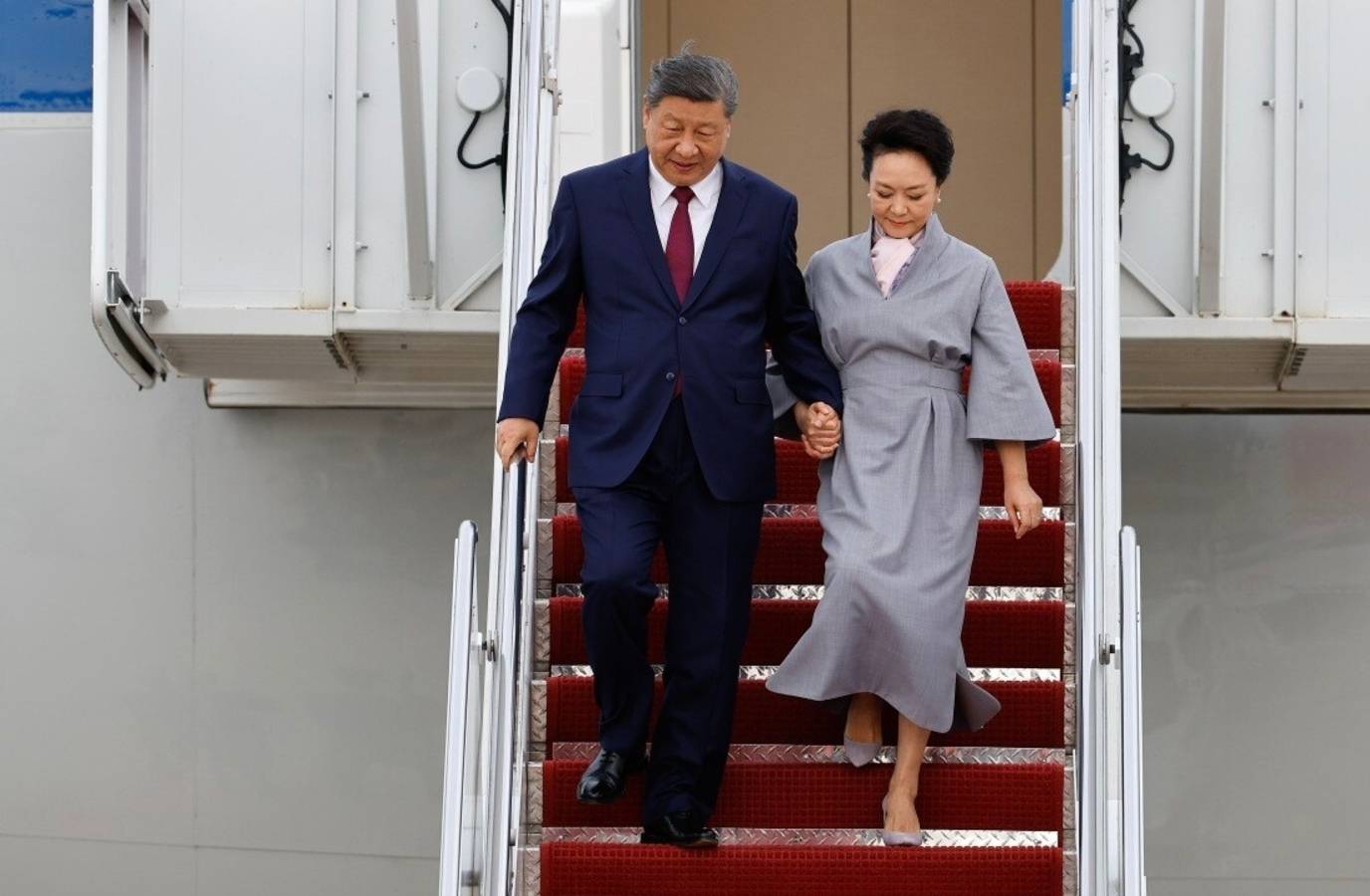
Before Xi Jinping became China’s most powerful leader in decades, he was better known across the country as “Peng Liyuan’s husband.” A celebrated army soprano and national household name, Peng helped burnish Xi’s public profile as he reached the pinnacle of power in late 2012.Last week in Washington, the Chinese leader again showed the world how much he relies on his glamorous wife—and not just ceremonially.As the two descended the stairs from their plane on Wednesday, Xi reached out, taking her hand as his other gripped the rail. On Friday, while walking the steep granite steps of the National Archives with President Trump and the first lady, Xi and Peng again held hands throughout the climb.It was a subtle gesture, but by the rigid standards of Chinese leadership optics, it was remarkable. Top officials don’t lean on their wives for fear of showing any signs of frailty. The spousal role on state visits has traditionally been decorative: waving, smiling and visiting cultural venues.While unedited video feeds of those scenes circulated internationally, prime-time broadcasts within China relied on carefully edited montages, highlighting the wave at the cabin door, formal tarmac greetings and archival handshakes. State media kept those moments of physical caution out of the central frame.None of this proves anything about Peng’s power. Nor does it say anything definitive about Xi’s health. But it opens a question worth sitting with: the person Xi visibly relies on in public—is that where her role ends?A role in China’s armyHere’s what’s on the record. Peng holds a noncombat civilian cadre rank equivalent to major general in the People’s Liberation Army. Appointed head of the PLA Academy of Art in 2012, she held senior military standing typical of the army’s top cultural figures until 2017, when the institution was absorbed into the National Defense University during a major military overhaul.Here’s what may lie behind it. Dennis Wilder, a former senior CIA China analyst who served on President George W. Bush’s National Security Council, told me that Peng’s actual work sits inside the military’s cadre-evaluation apparatus that vets those who run China’s military. “Xi relies very much on her Rolodex,” Wilder said. “He doesn’t have a PLA Rolodex like she has.”The logic, as Wilder laid out, is straightforward. Before Xi, now 73 years old, came to power, Peng, a decade younger, spent many years touring every major military command with her performance troupe, attending the banquets and getting to know the brass, Wilder said. In other words, he said, Peng had the map of who was loyal and who wasn’t.“She’s really the most powerful woman in China since Jiang Qing,” Wilder said.That name carries weight. Jiang Qing, Mao Zedong’s wife, led the Gang of Four, a radical faction that used the 1966-1967 Cultural Revolution to persecute perceived enemies and throw China into upheaval. Half a century later, Jiang is still the reason the Communist Party recoils at any hint of a leader’s spouse wielding power.Today, the reflex remains: keep the wives ceremonial, visible but harmless. Even the suggestion that Peng plays a role in military personnel decisions touches a nerve the party would rather not acknowledge exists. That may explain why so little about her actual influence is allowed into public view.Still, the woman Xi leaned on in Washington is worth watching. With no named successor and a shrinking circle of trusted advisers, the people Xi actually leans on are the ones who will shape what comes next.What do you think about Peng Liyuan’s role and her evolution? Write to me at [email protected]. Include your full name and location, and I might publish your response in an upcoming issue (if you’re reading this in your inbox, you can just hit reply).This is an edition of the WSJ China newsletter, a weekly dispatch of exclusive insights on the contest between the U.S. and China, brought to you by the WSJ’s top China correspondent. If you’re not subscribed, sign up here.The Summit in a Few HeadlinesThe Mao suit Xi wore to a White House state dinner carried a message.The state dinner was a chance for billionaire business leaders to mingle with Chinese dignitaries, top U.S. officials and President Trump.In-depth: There is concern in Taiwan that Trump might sacrifice support for the island in return for better relations with Beijing, and Xi sees an opening.Video: Xi came to Washington for three things: predictability, respect and TaiwanThe NumberThe U.S. and China agreed to reciprocal tariff cuts on some $30 billion in less-sensitive goods in either direction, as well as to launching an AI dialogue and their leaders meeting again twice later this year, in Shenzhen and Miami.A Closer Look By upgrading marriage registries with chandeliers, flower arches and poetry, local Chinese officials are glamorizing city hall weddings in hopes of encouraging young couples to marry and boost the nation’s declining birthrate.About UsWSJ China is a weekly newsletter with exclusive insights on the contest between the U.S. and China, brought to you by WSJ Chief China Correspondent Lingling Wei, with help from Zhao Yueling. Reach Lingling at [email protected] or at @Lingling_Wei on X (if you’re reading this in your inbox, you can just hit reply). Sign up to get an alert every time she publishes an article. Got a tip for us? Here’s how to submit.