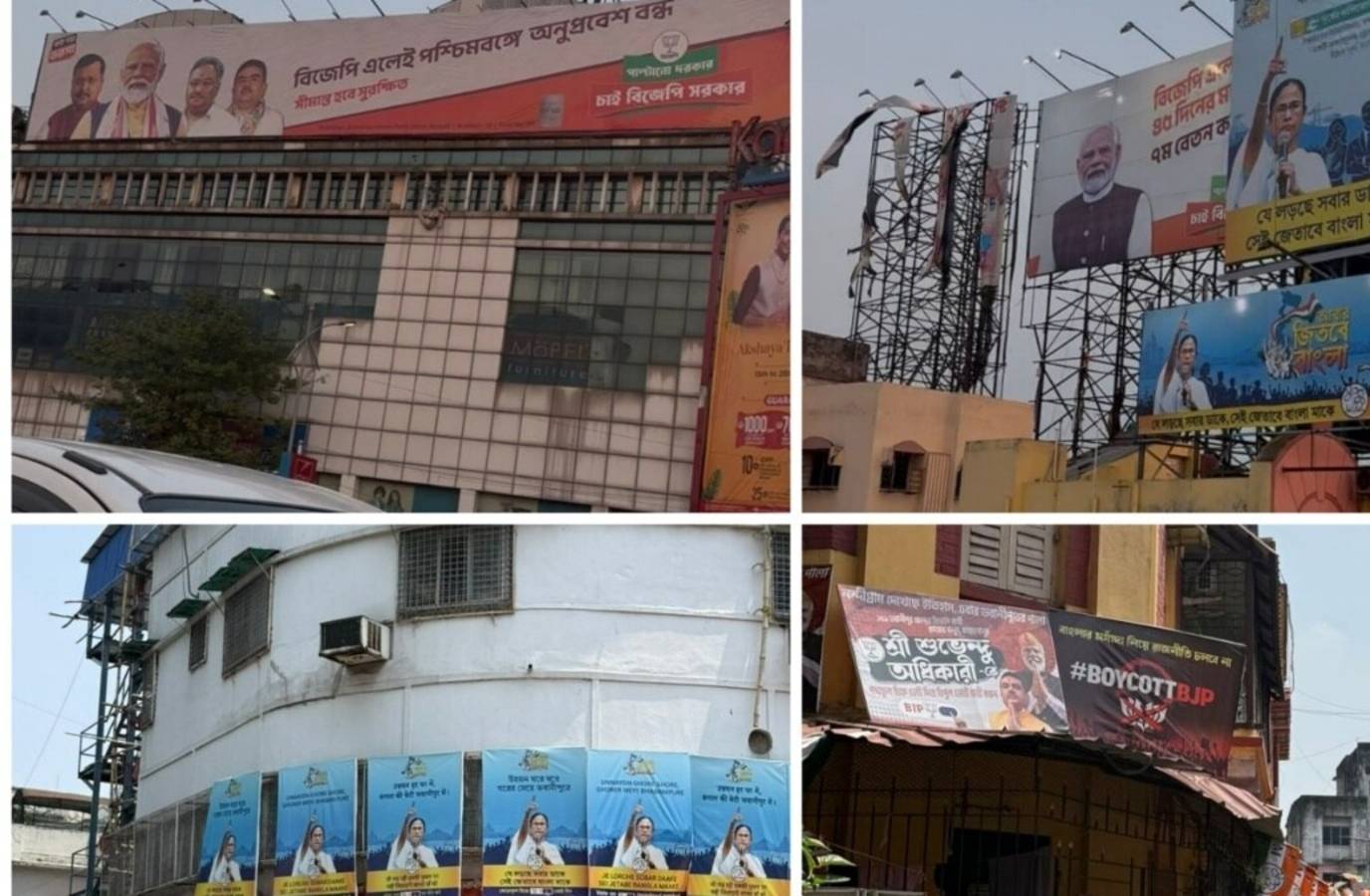
With voting days away in West Bengal, the city of Kolkata offers an early glimpse into the upcoming assembly elections. A mixed voter mood is evident, but one thing is clear: the Trinamool Congress (TMC) has taken a clear lead in the poster game.
The TMC has established a dominant visual presence, with posters featuring Mamata Banerjee and other party candidates lining arterial roads, neighbourhood lanes, and public spaces. In contrast, the Bharatiya Janata Party (BJP) has a relatively restrained visibility in the same format.
The BJP's poster game is notable for its light use of saffron shades, a colour traditionally associated with the party. In the Bhowanipore constituency, which is a key battleground, the BJP's visibility takes on a more localised intensity, with party posters and flags visible in pockets, especially closer to organisational hubs.
However, the BJP's campaign materials in Bhowanipore appear to use a lighter colour palette, with a greater emphasis on white tones rather than the party's traditional saffron-heavy imagery. A volunteer at the party office in Bhowanipore told me that the focus is on door-to-door campaigns rather than display.
The BJP is trying to unseat the Mamata Banerjee-led government, which has been in power for decades. The party's workers and volunteers are alleging that the TMC has carried out oppression and actions against the common man, leading to frustration and exhaustion among the people.
The TMC has not publicly responded to these specific allegations. The broader campaign environment in Bhowanipore reflects two distinct approaches: one centred on high-visibility public messaging, and the other on interpersonal outreach.