Records, Army grit and a fifth attempt: The stories behind Ladakh’s 122-km Silk Route Ultra | Hindustan Times
The runners begin at an altitude of almost 10,000 feet and, over 10 hours of complete darkness and sub-zero temperatures, have to gain another 7,600 feet.
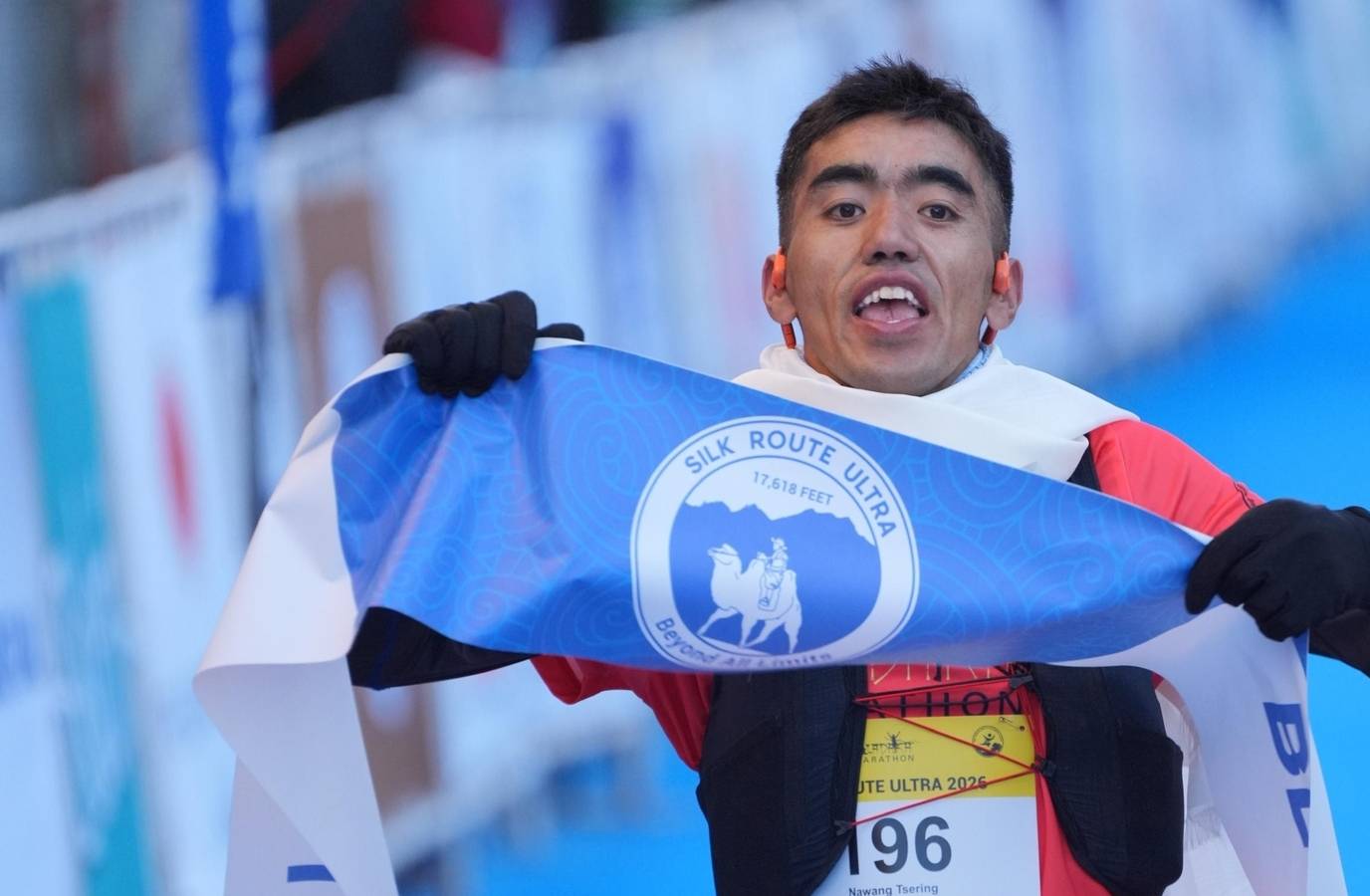
The 122-km Silk Route Ultra has everything that pushes you to your limit, especially when you are running in the challenging conditions of Ladakh. The SRU is currently the Ladakh Marathon’s most extreme ultra race. Only a select few runners from across the world make it to the start line, and if that isn’t enough to tell you about the gruesome nature of the race, each runner has to run for around 10 hours in pitch darkness, in sub-zero temperatures, across the raw, rugged mountains of the trans-Himalayan range. The race starts from Kyagar Village, around 117 km from Leh.The runners begin at an altitude of almost 10,000 feet and, over 10 hours of complete darkness and sub-zero temperatures, have to gain another 7,600 feet to reach Khardung La, making it one of the most brutal elevation gains in any road-running event. It may be seen as a test of endurance and physical preparation, but the Silk Route Ultra is equally a mental battle.You definitely need some big motivation when you take on a race of this magnitude, and there are a few runners providing exactly that this year. Among them are past winners, as well as a runner who recently completed the UTMB. Ahead of the 2026 edition of the Ladakh Marathon, they sat down with Hindustan Times Digital for an exclusive interview, where they spoke about their journey, their approach and how they have prepared for this year’s Silk Route Ultra.Nawang Tsering, who recently completed the Ultra-Trail du Mont-Blanc (UTMB), clinched the top spot in the Silk Route Ultra this time, finishing the race in a record 12 hours, 12 minutes and 18 seconds to script history in Ladakh.Before the race, however, he admitted there was some pressure with the attention and expectations surrounding his return to the Silk Route Ultra. With last year’s winner and another former champion also in the field, he knew the competition would be tough, especially with the local Ladakh runners also preparing well."There's a little pressure because this year, look, last year's Silk Route winner is here, and before that, another Silk Route winner is here too. There'll be competition. And other people who... the Ladakh runners, they're also practising well. Everyone... seeing all of them, they're also practising well, so the competition will be good and tough," Nawang told Hindustan Times.But when it comes to the medical checks before the race, Nawang suggested he does not allow that thought to occupy his mind and believes the focus should simply be on giving his best without taking unnecessary risks."I don't think about that - not at all. I don't think about the medical aspect at all. You just have to give your best. No issues with the medical, no taking risks, and you shouldn't even stress about it - just focus on that," he said.Twesang Kundan, who has been serving in the Indian Army, won the SRU last year, finishing the race in 13:50:01, but missed out on the podium this time. His journey, however, is nothing short of inspiring. On the eve of the race, he spoke about how he started running and how his experience of serving in the Indian Army has helped him finish on the podium in some of the most difficult races and marathons."Running, I used to do since school time, sir. But as a professional... as a good runner, whatever... I learned everything after coming to the Army, sir. Since joining the Army, I have won many podiums... After coming to the Army, I learned a lot," Twesang told Hindustan Times Digital.For a runner taking on one of the toughest ultras in Ladakh, the challenge begins well before the start line. Twesang spoke about handling the pressure of medical tests and physiological checks, and why staying mentally calm is just as important as physical preparation."If we control the pressure, then it will be very good in the game. If you go into the game taking pressure, then that game can get spoiled," he added.When it comes to the race itself, Twesang believes in starting at a controlled pace before adjusting his approach as the incline gets tougher. He also spoke about alternating between running and jogging, while keeping hydration and energy intake in check throughout the race."From here in the starting, my pace remains normal. So I take that same pace up to around 30 kilometres, sir. Then after that, when incline comes... I slow down my pace a bit, and in between I run, jog, run, jog... like an interval. So that gives me quite a lot of benefit," he said.Having won the women’s category at the Silk Route Ultra last year, Sufiya Sufi has plenty of experience when it comes to extreme runs. But she also knows what it takes to make the shift from marathon running to ultra-distance races. She spoke about how different the training is for the two, and why, beyond endurance, mindset plays the biggest role in an ultra."A marathon runner and an ultra-distance runner both have a lot of differences, and the training for both is very different. In ultra-distance running, your endurance should be very good, and even more so, your mindset. It's all mindset. If your mind is that strong, and you have to prepare for the worst. We shouldn't think about an easy situation. You have to think of the worst. So it's all mindset, I think. You have to prepare your mindset for long-distance running. Marathons have a big role of strength; their training is different, you have to work a lot on speed. So I think that's the difference between the two. And shifting doesn't take much time, actually, because you are already running. Just what you need to work on is mindset," she said.Sufi also talked about how her preparation has been different this time, especially after recently completing the 5,000-km Kanyakumari to Karakoram run and still being in the recovery phase."Last year I won this race, Silk Route Ultra, and after that I did a lot of runs. And recently, I did the Kanyakumari-to-Karakoram 5,000 km. I think it hasn't even been a month. And it's been advised that I do not go for long running because I'm in a recovery zone. I'm recovering, but I told them, let me go, I'll go easy, let me finish this run because it is very close to my heart. This will be my third SRU, and in Ladakh, I always need an excuse to come. So I was looking for this, and let's see, hope for the best, how it goes," she added.Having already completed the Silk Route Ultra, Sufiyan knows that a race of this distance needs more than just physical preparation. She spoke about the importance of having a clear strategy, setting targets at different stages of the race and keeping the cut-off time in mind."Of course, strategy, you work with strategy. Because when you set a target that we have to finish our run in this many hours, you keep a target at every stage that we need to reach by this time. Same way I also set a target for myself that if I have to finish in 18 hours or 19 hours, then according to that, how many hours before the cut-off we need to reach. So I think that strategy is always there for every athlete," she said.Meanwhile, there is another story at the Ladakh Marathon - of a runner returning for his fifth attempt at the Silk Route Ultra after failing to finish the race on his fourth. Yet, the same passion, smile and never-give-up attitude continue to drive him back to Ladakh.This was Tarang Wadhvani’s fifth attempt at the Silk Route Ultra, but despite the challenge of running at such a high altitude, he continues to return to Ladakh. This time, he finally did it, with a sigh of relief on his face, alongside the smile that had barely left him since he arrived in Ladakh. Before the race, he spoke about why he considers himself a recreational runner, what the race teaches him about his own toughness, and how the people, culture and hospitality of Ladakh keep bringing him back."See, our primary target is always just to finish - that we are able to complete it. Then, depending on how our first cut-off and second cut-off go, we decide the rest of our strategy within the race based on how we feel. If it's too cold or if we get breathless, we slow down. If the body feels comfortable, we start running faster, depending on the situation. Up to Khardung La Top (K-Top), we take it very easy and show respect to the mountains and the altitude. So that's how our race unfolds. Race preparation isn't always the same; the route is the same, but in terms of preparation, we always learn something new from the local athletes here and implement it in our next training cycle. We get to learn a lot; runners come from outside, and elite runners have also started coming now. So we learn new things from them. Some people come here two or three months in advance to train, so there's a lot to learn from them as well," he added.