The latest attacks on oil-and-gas infrastructure in the Persian Gulf region have marked a dangerous new phase for the U.S.-Israeli war with Iran, worsening an energy-supply crisis that is already spreading rapidly across the globe.
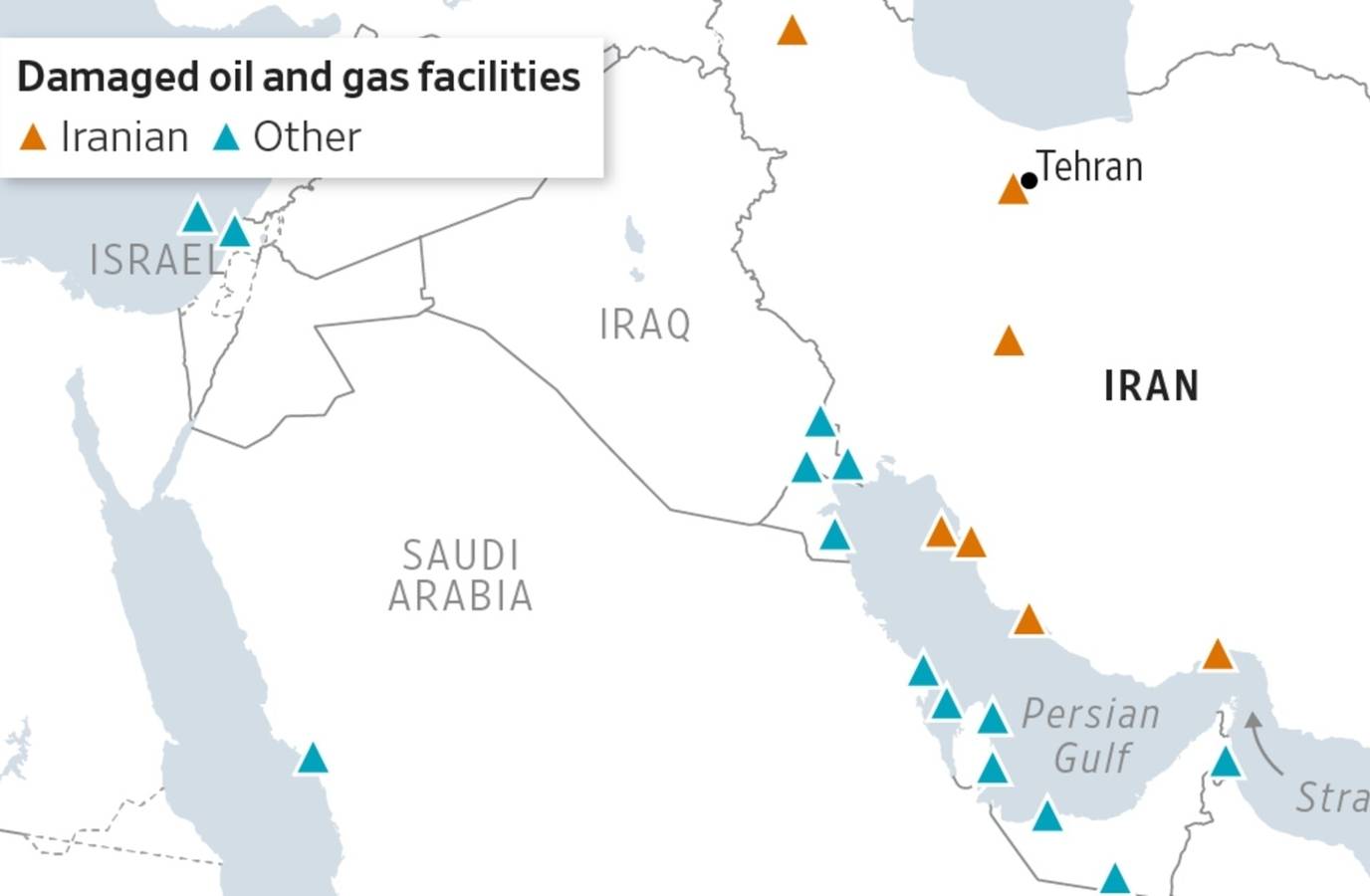
Israel on Wednesday struck facilities at Iran’s giant South Pars, part of the world’s largest gas field, shared by Iran and Qatar. South Pars produces 730 million cubic meters of gas a day, mostly for Iranian users.
Iran, having warned of an attack on its energy assets as a red line, rapidly retaliated.
Between Wednesday evening and Thursday morning, several energy facilities in Qatar, Saudi Arabia and Kuwait were attacked.
Qatar’s Ras Laffan Industrial City, the site of the world’s largest liquefied-natural gas plant, was attacked twice.
Iranian ballistic missiles caused extensive damage to Pearl GTL, the world’s largest gas-to-liquids plant, developed in a partnership of Shell and QatarEnergy.
Separately, a missile barrage was fired at Riyadh on Wednesday evening. Debris landed near a refinery that has a capacity of around 130,000 barrels a day and serves Riyadh’s domestic-fuel market.
Attacks continued Thursday, with drone strikes hitting Kuwait’s Mina Abdullah and Mina Al-Ahmadi refineries.
Fires are under control, but operations at both refineries are suspended.
To the west, Saudi Arabia’s Samref refinery in the Red Sea port city of Yanbu was hit.
A ballistic missile was fired toward the Yanbu port but was intercepted.
The port is crucial for Saudi oil exports.
With the effective closure of the Strait of Hormuz, the kingdom has relied heavily on pumping crude through its east-west pipeline to the port of Yanbu, and from there to global markets.
Disruptions there could remove 5 million to 6 million barrels a day from the market and potentially push oil prices to $150 or higher, according to Aditya Saraswat, an analyst at Rystad Energy.
The U.S. on March 13 bombed military targets on Kharg Island, a spot of land a third the size of Manhattan that is the launch point of roughly 90% of Iran’s oil exports.
Although oil facilities on the island were spared, President Trump warned that he would reconsider if Iran didn’t open the Strait of Hormuz to international shipping.
The Shah gas field, southwest of Abu Dhabi and home to the world’s largest ultrasour gas operation, had a drone strike Tuesday.
The fire there is under control, but operations have been suspended.
Ultrasour gas is used to produce petrochemical feedstock and methane for heating and cooking.
Saudi Aramco’s Berri oil field had minor damage on March 7 by debris from an intercepted drone.
Several Iranian fuel-storage facilities in Tehran belonging to the Islamic Revolutionary Guard Corps were struck that day.
Saudi Arabia’s Ras Tanura oil refinery suspended operation after an Iranian drone hit an oil-storage facility at the site.
The complex was again targeted on March 4.
The refinery has restarted.
The United Arab Emirate’s port of Fujairah, a hub for oil loadings outside the Strait of Hormuz, has been repeatedly hit by drones.
It is also a hub for oil storage, trading and ship refueling.
Operations at the port have been on and off for days, raising concern about the vulnerability of alternative oil routes that bypass the strait.
Iran has repeatedly hit tankers near the Strait of Hormuz, the maritime chokepoint through which 20% of the world’s oil and liquefied-natural gas supply passes.
The attacks have alarmed shipowners, charterers and seafarers, reducing traffic in the Strait of Hormuz to a trickle.
Between March 1 and March 18, there were only 98 transits through the strait, marking a 96% drop compared with the latter half of February, according to S&P Global Market Intelligence.