Canva's latest AI push may seem like just another feature update, but it's actually a culmination of years of building strong foundations in AI. Co-founder and Chief Product Officer Cameron Adams shares the company's approach to developing AI models, which involves investing in their own models when they see a competitive advantage or when customers' needs aren't met by existing solutions.
Adams points to the background removal feature as an example of a task that can only be fully completed with their own models. Canva has over 100 dedicated AI researchers and has sharpened its focus on foundational model capabilities after acquiring Leonardo.ai a couple of years ago.
The Canva Design Model, released in October, is a key component of the company's AI 2.0 portfolio. It's a parallel to human design capabilities, understanding finer aspects of design, from structure to layering to hierarchy, with elements of branding and editable content. The model is designed to work alongside a human, not replace them.
Adams believes Canva has a unique advantage in model training due to its 14 years of design knowledge and expertise, as well as a massive content library of templates, images, and videos. This allows the company to understand design in a more complex way than text and code LLMs.
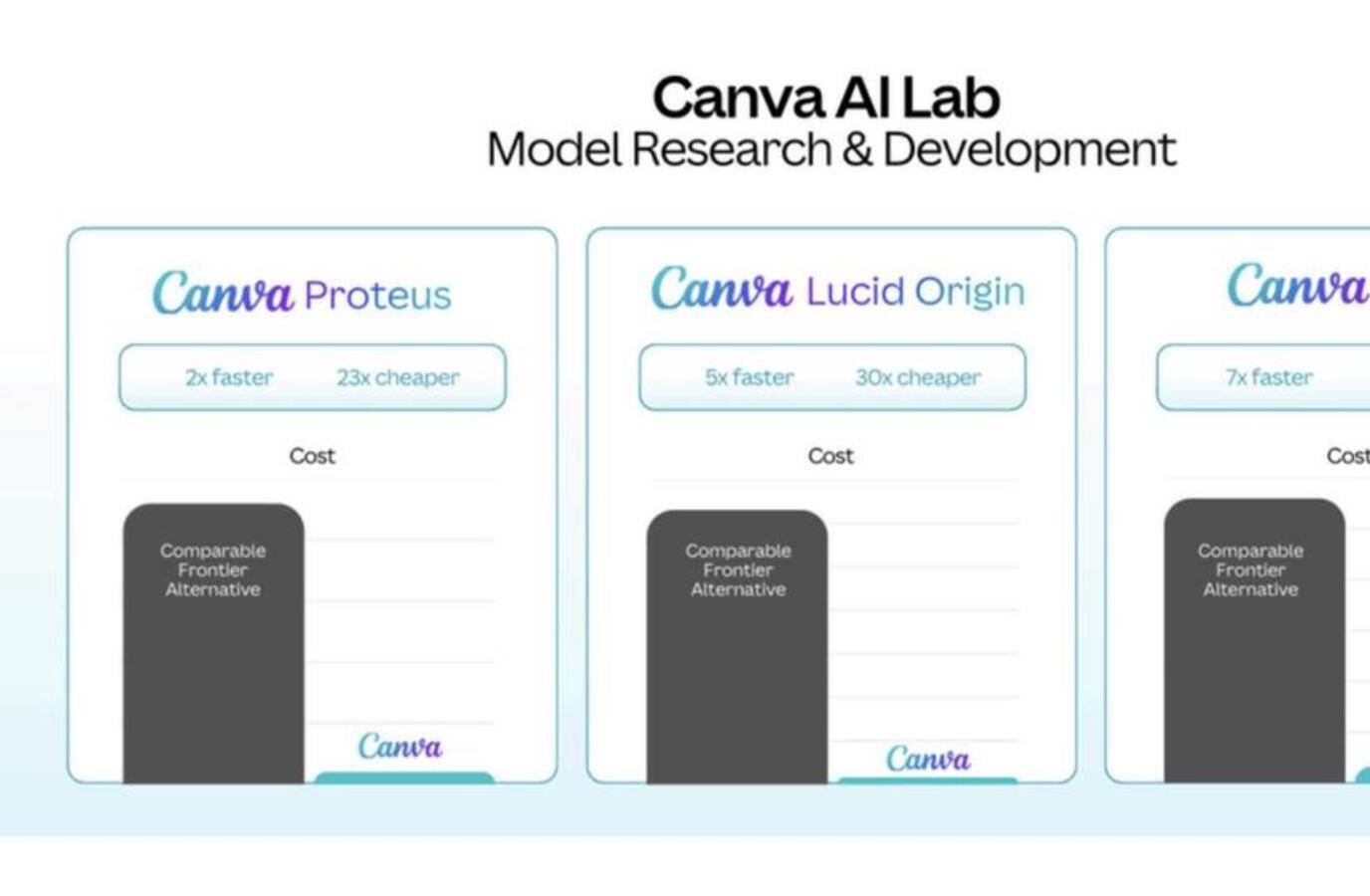
Co-founder and Chief Operations Officer Cliff Obrecht highlights the importance of creating a variety of models at scale, particularly for Canva's large free user base. The company's fission models are significantly cheaper than frontier models, allowing them to power a lot of their workspace for free users.
Canva is shifting towards on-device models, which are more cost-effective and private. Obrecht believes the company is ahead of the curve in this area and is preparing to provide powerful features to its huge free user base at very affordable prices.
Canva's approach is focused on making specific workflows more refined, rather than competing with OpenAI or Google. This strategy may not be the loudest, but it's certainly a cost-effective one.