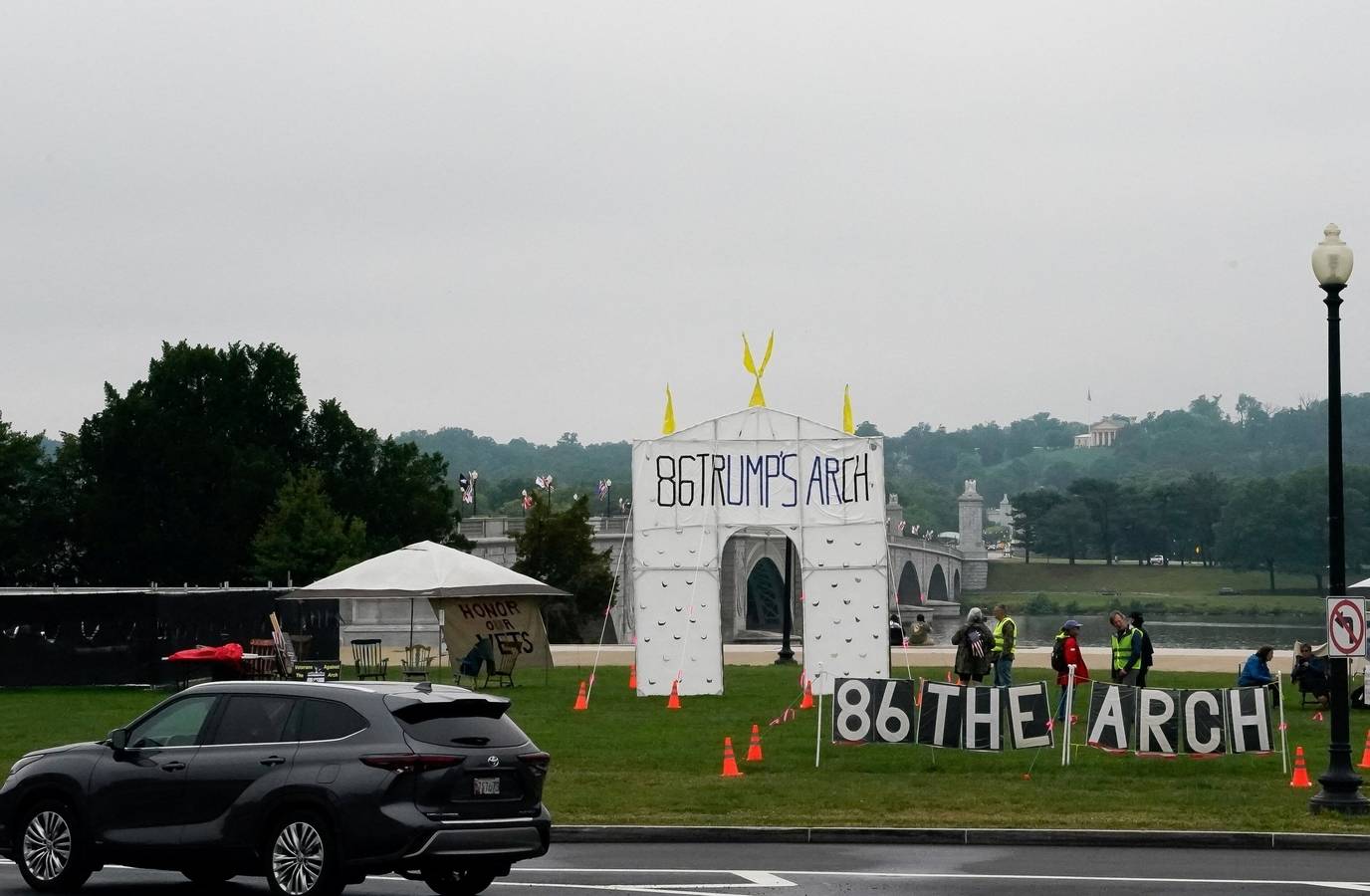
WHO SAYS 70 is too old to raise hell? Not Susan Douglas. Boomers like her are the backbone of the resistance to Donald Trump—the median age of No Kings protest organisers is 67. His schemes to remodel the capital keep them busy.
Recently her group held a three-day vigil near the site of his planned triumphal arch. They did a “resistance dance” and sang along with a “rapid-response choir”. Then they descended on a meeting of the National Capital Planning Commission (NCPC), a zoning board tasked with reviewing the project, to avail themselves of the opportunity for public comment—and give Mr Trump’s lackeys on the committee an earful.
At 250 feet (76m) high, the arch is ostensibly meant to commemorate America’s semiquincentennial. The president revealed its true intent when, asked last year what it would memorialise, he replied “Me”. That the form recalls a passé imperial aesthetic was not lost on anyone at the NCPC meeting: a near-competitor, height-wise, sits in the North Korean capital.
Commentators called Mr Trump’s iteration an “ego arch” and “silly silliness”. Ms Douglas declared herself “horrified!”
Perhaps even more than its campy style, it is the arch’s proposed site that is unsettling its opponents. Mr Trump wants to put it in Memorial Circle, a roundabout on the axis connecting the Lincoln memorial to Arlington cemetery, where veterans are buried.
Atpost that cemetery lies the mansion where Robert E. Lee lived before he defected to lead the Confederate army. The direct view between his old stomping ground and the memorial to the man who freed the slaves was a deliberate choice by city planners in the 20th century: a symbol of reunification after the civil war.
Mr Trump’s monument-to-me would be a 25-storey obstruction of that sight line. Moreover, the approach to Arlington is meant to be sombre and reflective, not triumphal, as Holly Berkley Fletcher, a historian, noted at the NCPC meeting.
A victory arch rather misses the point of memorialising veterans. The reason to honour them is not because they “won” anything but rather because they sacrificed themselves, says Bryan Green, an architectural historian.
By law Congress is supposed to approve memorials near the Mall. Mr Trump’s excuse to bypass lawmakers is to cite an authorisation granted in 1925 to build two slender columns, each 166 feet high, in roughly the same spot.
Herbert Hoover scrapped that plan. David Scott Parker, a preservationist, likens the unbuilt columns to candlesticks framing your view across a dinner table—whereas Mr Trump’s arch is a giant wedding-cake centrepiece “which is quite something else”.
Mr Trump’s builders intend to make the arch out of cast concrete and clad it in granite. A structure so heavy will require months just to prepare the foundation.
Courts will probably block the project before then—a judge is weighing whether to do just that, in a lawsuit brought by veterans.
Mr Trump’s other building projects, from the White House ballroom to the renovation of the Kennedy Centre, have been held up in court too.
Commentators at the NCPC acknowledged as much. “The question before you commissioners today, then, is not the future of the arch,” implored one.
“It’s your personal legacy.” Unpersuaded, the commissioners advanced the proposal by a vote of 9-1.
Then Mr Trump thanked them on social media; they reposted his post; and Ms Douglas and her crew went to plot their next move.