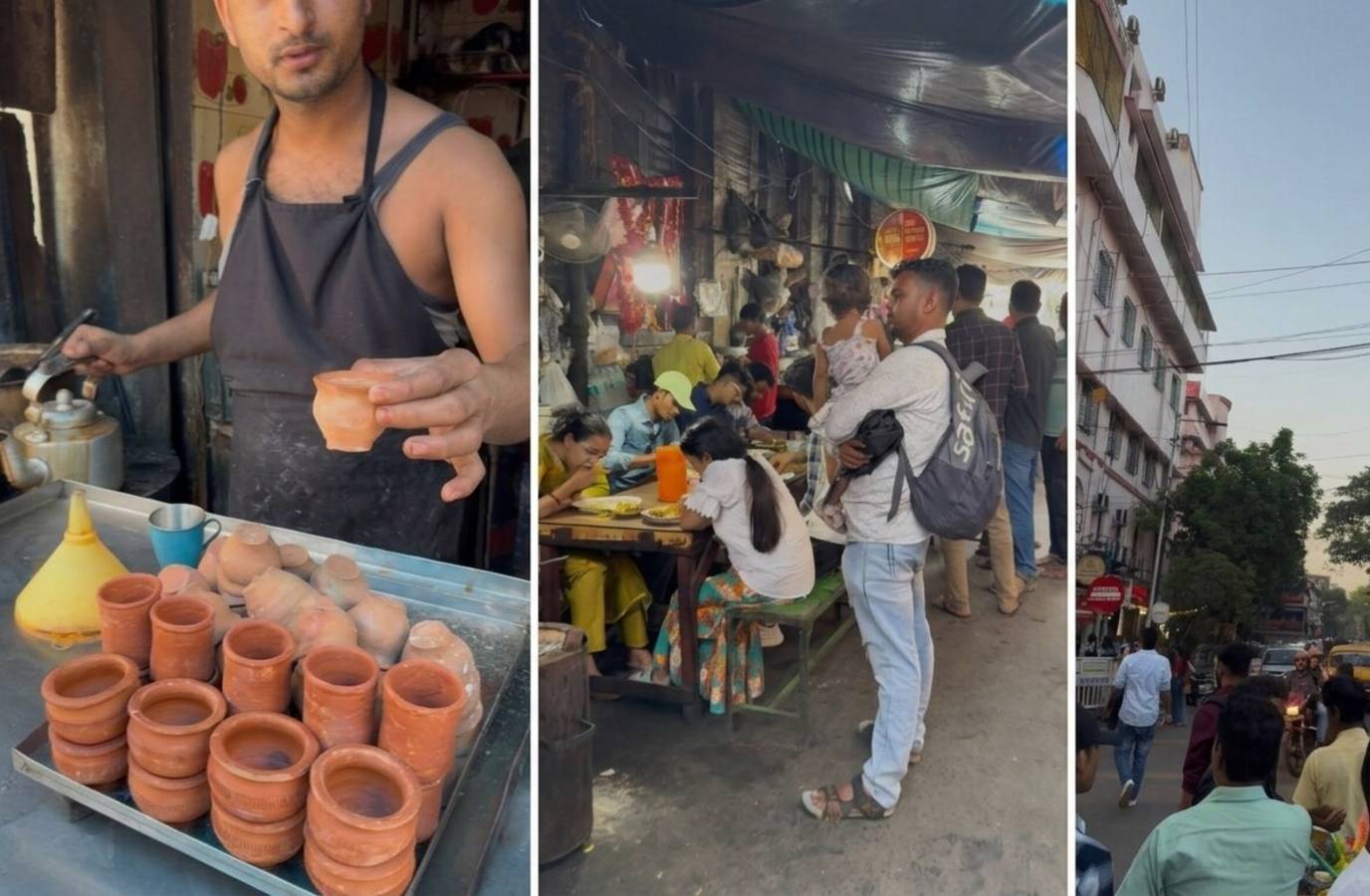
At lunchtime in Dacre's Lane, the narrow stretch of food stalls tucked behind Kolkata's Esplanade, the usual rush hasn't changed --- office-goers still crowd around plates of chicken stew and rice, tea is poured endlessly into small glasses, and cigarettes pass quickly between fingers --- but as West Bengal heads into voting on April 23 and 29, something in the conversations feels different.
Election conversations and political discussions as well as debates are everywhere all the time and only get amplified during the election season. Yet unlike past campaigns marked by loud political certainty, many discussions now unfold in lowered voices, measured sentences and unfinished thoughts.
People still talk about the contest between the Trinamool Congress and the Bharatiya Janata Party, but often in lowered voices, sentences trailing off before they reach a conclusion.
"It's very difficult to say," said Bardesh Paswan, a worker at the famous Chitto Babur Dokan, a street food stall serving comforting Bengali meals since the 1940s in iconic Office Para or Dacre’s Lane.
"What is inside you, you understand; what is inside me, I understand. Nobody wants to reveal it publicly - people keep their thoughts within themselves." Paswan's words captured a recurring sentiment heard across central Kolkata: people are watching closely, but declaring political preferences has become rare.
"Everyone wants change. Everyone wants to feel better," he added. "The person earning ₹100 a day wants peaceful sleep, and the one earning ₹1,000 wants the same. But are people really able to get that?" he said.
Confidence, but a caveat added
Not everyone hesitated. Another regular at Office Para, Saurabh Pandit, speaking emphatically amid the bustle, expressed clear support for chief minister and TMC supremo Mamata Banerjee.
"Jai Bangla, Mamata Banerjee. No doubt," he said. "Politics should not happen in the name of religion. It should be about work. Some work is done, some is incomplete - give time."
"Whoever comes to power, no minister or leader tells us exactly what to do. Ultimately, it depends on us - what we do and what we don't do. Today everything is visible because cameras are on everywhere, but go back 10-20 years and nobody knew anything. Problems happen everywhere; they take time to fix. You have to give time to handle things," Pandit said, seemingly in support of the incumbent government.
Also read: Mamata Banerjee, Suvendu Adhikari to face-off once again in 2026 West Bengal polls
In what appeared to be a message for the BJP and over the Special Intensive Revision (SIR) exercise by the Election Commission of India, Pandit said, “Politics should not be done in the name of religion. It should be about work… Why is everything a queue - dying in a queue, being born into a queue? How long will people keep standing in lines?“Ninety lakh people are being told they will get voting rights with only days left. How will that happen in two months? These things should be planned years in advance… Why was SIR not conducted a year or two ago?" he said.
Pandit was referring to the removal of over 90 lakh names from the Bengal electoral rolls by the ECI after the SIR exercise.
Also read: Has SIR altered West Bengal’s electoral map ahead of assembly elections?
On fears around food choices becoming political issues, Pandit said, "Everyone has their own religion and food habits… Nobody can suddenly stop people from eating what they want. We will eat, drink, laugh and live freely."
Even among supporters, however, the conversation returned repeatedly to governance rather than ideology - queues for services, documentation issues, and daily administrative struggles.
A few steps away, another resident, Anutapo Sanyal, summed up the prevailing uncertainty.
"Honestly, it is difficult to say right now," he said. "There is some doubt about whether the ruling party will continue. Nobody can predict what will happen - we will have to wait and see."
On whether the BJP still carries an "outsider" image in Bengal politics, Sanyal was more definitive: "This is India. Any government here is part of India. I don't think BJP should be seen as an outsider."
New Market's guarded mood
In the New Market area, traders echoed the same reluctance to speak openly.
"Right now everyone is silent. Nobody talks openly," said VM Shukla. "Whoever wants to support will support - maybe out of fear, maybe blind support. People who speak clearly are hardly one or two percent" Shukla, a resident otherwise of Dharamtala, told hindustantimes.com at New Market.
Asked what voters want from the next government, his answer avoided party politics altogether.
"Protection. A better environment. Business should run well."
Whether the ruling Trinamool Congress would return to power, he paused before replying: "Anything can happen this time. Nothing is certain."
Also read: Mamata announces 10 key promises in manifesto - Pucca house, more financial support to women
Welfare and youth aspirations
In Park Street, conversations revealed another layer of the electoral mood.
Rani Jana, at the legendary eatery called Mocambo, said welfare schemes such as the Lakshmi Bhandar allowance continue to resonate strongly with women voters.
"People are excited about it," she said. "But among the youth there is sentiment for change because of unemployment and lack of opportunities."
Yet she too stopped short of predicting a shift in power. "Outside Kolkata, many still want to stay with TMC," she said she believes, suggesting that the BJP faces a difficult path to make inroads in Bengal.
"Among the youth, I feel there is a sentimentality regarding a change of power and government in the state, mostly because of unemployment issues. A lot of them are talking about the fact that there's not many work opportunities or job opportunities within the state. So I think the youth wants a change. But then again, this is only related to Kolkata. People who live outside Kolkata, I think they're pretty sure about their… like they want to be with TMC, so it will be difficult for BJP to come to West Bengal for sure," Rani said.
Also read: ₹3,000 aid to women, youth">BJP's manifesto pledges UCC in Bengal, plugging infiltration, ₹3000 aid to women, youth
Across locations - Office Para, New Market and Park Street - one pattern stood out: voters spoke more about livelihood, safety and stability than political rivalry.
What emerged is neither a clear wave for change nor an overwhelming endorsement of the incumbent government. Instead, Kolkata's electorate appears to be in a phase of quiet calculation.
As one trader put it simply: "What does the common public want? Food, peace, love and respect."
After spending the day across several locations in Kolkata, I found that while election conversations exist everywhere, very few people are willing to speak about them on camera. At Office Para and New Market, only a handful agreed to share their views, while many others declined or spoke only off the record.
One of those informal conversations revealed something telling - a visible hesitation among voters. Several individuals said that openly naming political parties or expressing what they feel is the mood of the people publicly could invite trouble, with some even suggesting they might have to "change addresses" if they spoke freely.
The mood, therefore, at least in parts of Kolkata, is neither loud nor openly polarised, but cautious, watchful and marked by an undercurrent of fear - setting the stage for what could be a closely watched electoral battle.
In the city's addas this election season, certainty is not much on record. Conversations continue, but often in whispers - revealing an electorate that is watching closely, weighing options carefully, and choosing caution over declaration and making the West Bengal elections 2026 a keenly-watched battle.